To imagine something that doesn’t exist yet and transform it into reality is the definition of creativity. That’s what engineers and computer scientists do every day. At the Molinaroli College of Engineering and Computing’s second annual STEMart event, students were challenged to take it one step further – to translate their innovations into art.
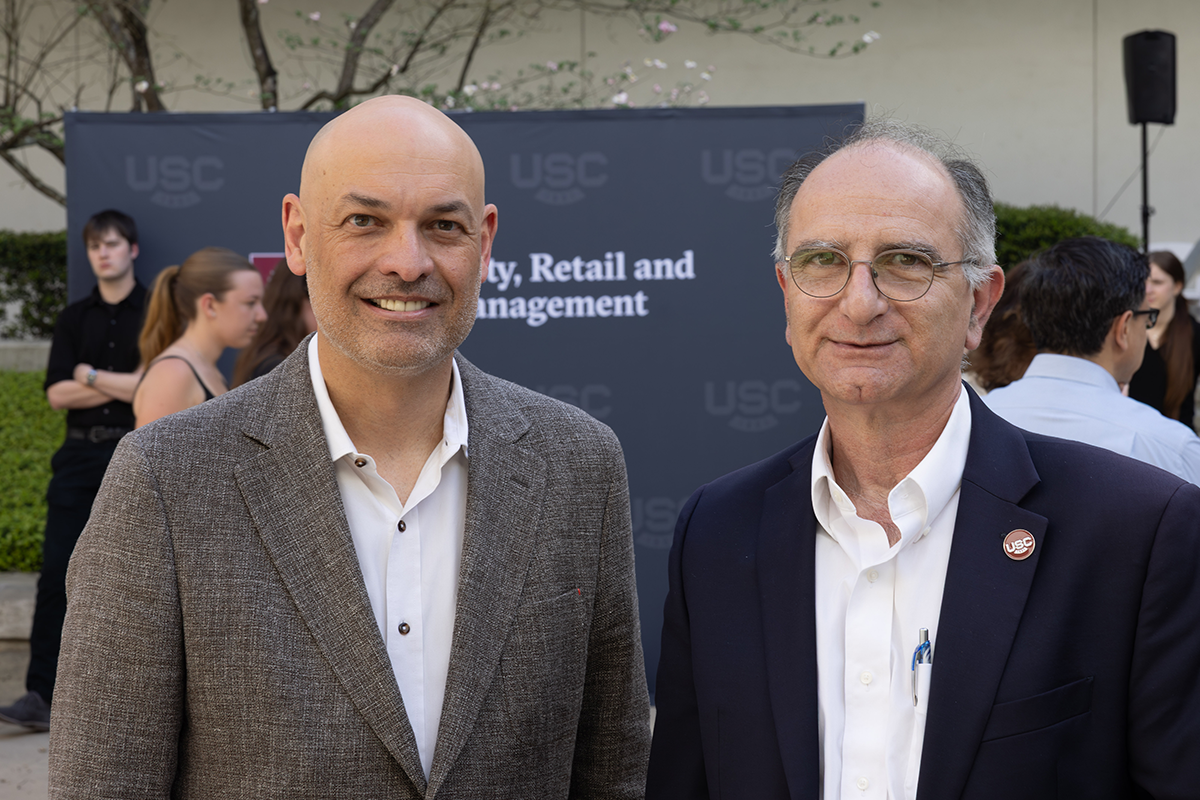
“This artwork represents what goes on in this college,” said Molinaroli College Dean
Hossein Haj-Hariri during opening remarks. “It’s all about creativity, how our brains
are wired. All of that is art. We create art.”
Held April 2, the event brought together Molinaroli College and the College of Hospitality,
Retail and Sport Management under the theme “Bridging Art and Engineering.” Supported
by MCEC alumnus Jim Wiseman (’79 mechanical engineering), president of development
for Margaritaville, STEMart invited students to display original pieces that reflect
the intersection of technical skill and creative thinking. A juried competition awarded
a $1,000 scholarship to the top entry.
Haj-Hariri emphasized that creativity is foundational to engineering disciplines,
pointing out that many MCEC students are also musicians, designers and creators in
other forms.
“Code itself is artsy, when you look,” he said.
That mindset was evident throughout the exhibition. Students and attendees gathered
to study works that blended visual art with engineering principles – mathematical
equations embedded in sketches, algorithms woven into compositions and technical concepts
translated into tangible forms.
Computer science student Joe Hardy’s piece, Encoded City, illustrated this connection. His drawing of a skyline incorporated lines of code
into the night sky, with each illuminated window representing a binary character.
“Doing art helps me think more creatively when coding and solving problems,” Hardy
said. “We are stronger together, and smarter together.”
The STEMart initiative itself grew from a conversation between Haj-Hariri and Wiseman
during a tour of the engineering complex. Noticing the stark interior spaces, Wiseman
envisioned a more dynamic environment: one that reflects the creativity of engineering
students and alumni. His support helped launch the event and continues to inspire
enhancements across the college, including plans for murals and outdoor design projects.
“He brought us on this path,” Haj-Hariri said. “Without his support, we would not
be here.”
Wiseman’s involvement underscores the critical role alumni play in shaping the student
experience at the Molinaroli College of Engineering and Computing, not only through
philanthropy, but by encouraging new ways of thinking about engineering education.
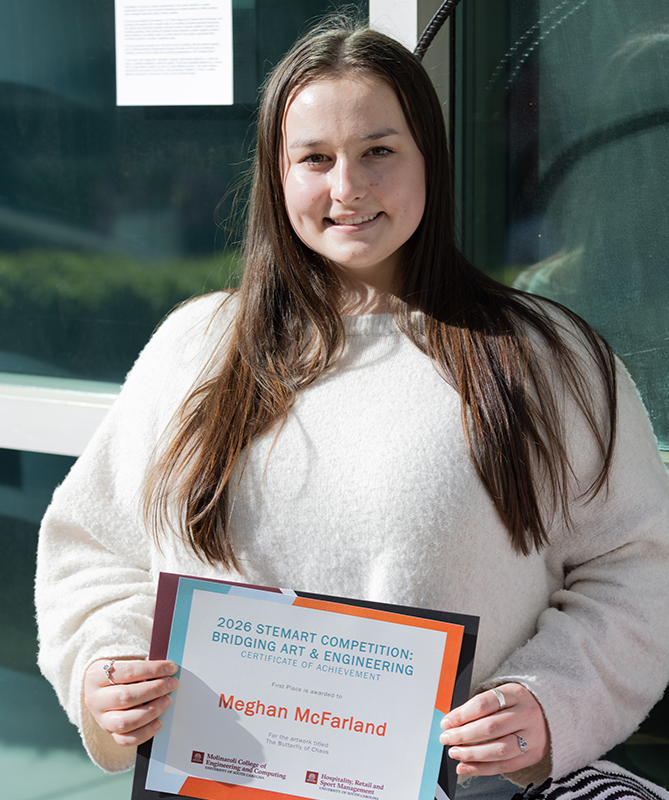
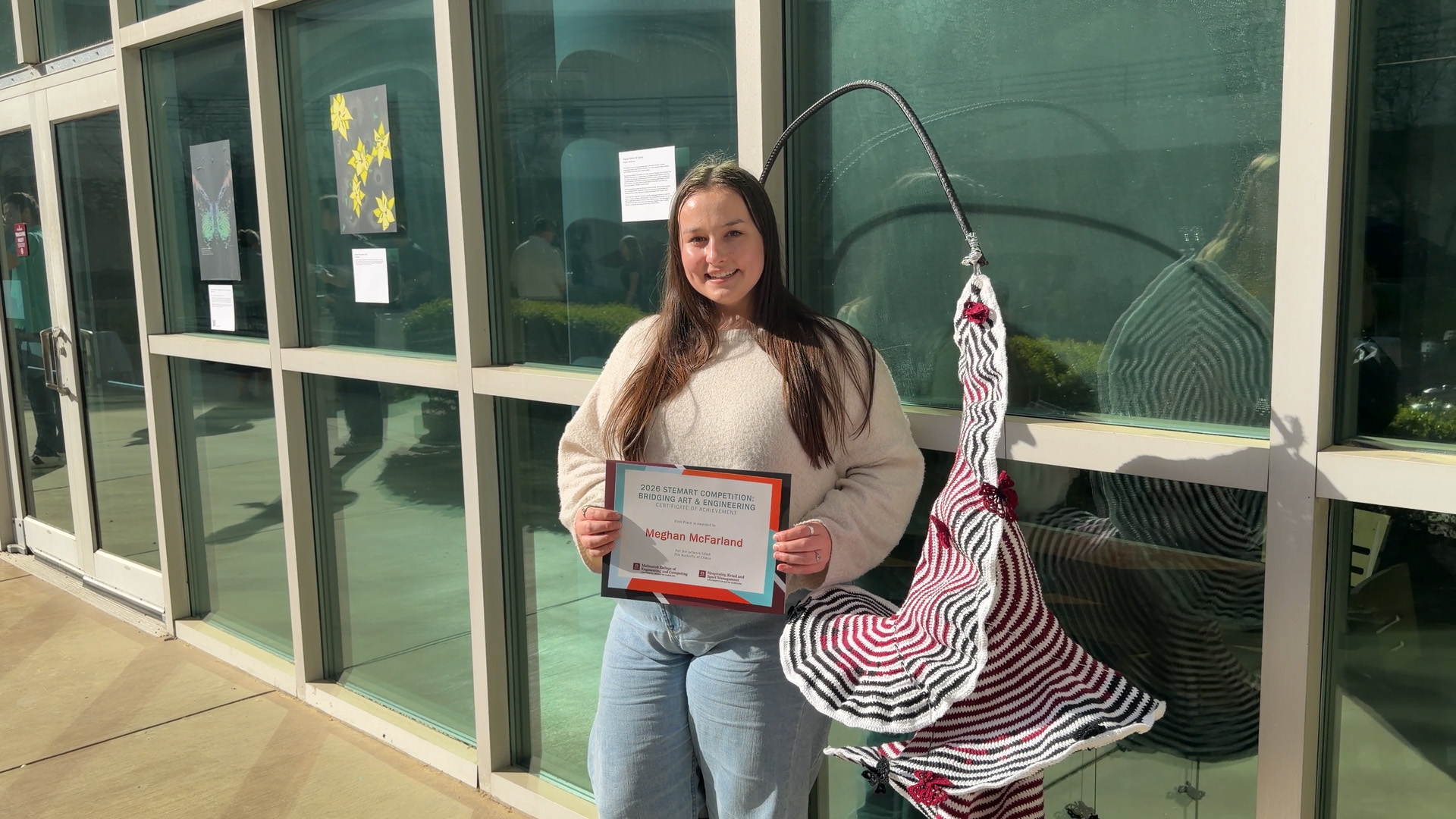
The evening’s top honor went to Meghan McFarland, a junior studying biomedical engineering,
for her crocheted sculpture Butterfly of Chaos. The piece interprets chaos theory, often referred to as the butterfly effect, through
a tactile medium, translating a complex scientific concept into an accessible visual
form.
“I explain it as a tangible way to boost intangible concepts,” McFarland said. “I
was inspired by women in STEM using art to bridge the gap between math equations and
art.”
Michael Sagas, dean of HRSM, noted that the collaboration reflects a broader shift
toward interdisciplinary problem-solving.
“We are using art to solve scientific problems,” he said. “We are working to show
the emotion, meaning and purpose in innovation.”
For Haj-Hariri, STEMart represents more than a single event. It reflects the Molinaroli
College’s culture, where creativity drives discovery and alumni engagement continues
to expand opportunities for students.
“If you can’t build it,” he said, “then create it.”