Skip to Content

Arnold School of Public Health

People


Mohammed Baalousha

Mohammed Baalousha, Ph.D.

Principal Investigator

Associate Professor of Environmental Nanoscience
Center for Environmental Nanoscience and Risk
Department of Environmental Health Sciences
Arnold School of Public Health
921 Assembly Street, RM 501C
Columbia, SC, 29205

B.S., 2001, Islamic University of Gaza (Palestine)
M.S., 2002, University of Bordeaux (France)
Ph.D., 2006, University of Bordeaux (France)


Contact

Saleh Almasoudi

Saleh Almasoudi

Graduate Student | Lab Manager

B.S., Chemistry, 2012, Umm Al-Qura University, Makkah, Saudi Arabia
M.S., Environmental Science, 2021, King Abdulaziz University, Jeddah, Saudi Arabia
Ph.D. Candidate, Environmental Health Sciences, University of South Carolina

Saleh’s current research focuses on the occurrence, persistence, and environmental behavior of environmentally persistent free radicals (EPFRs) in wildfire and wildland-urban interface (WUI) fire ash.

Recep Kanber

Recep Tayyip Kanber

B.S., Chemical Engineering, 2014, Gazi University, Türkiye
M.S., College of Forestry, Wildlife and Environment, 2019, Auburn University

Recep’s current research focuses on monitoring and characterizing the properties of metal(loid)s and nanomaterials released from fires at the wildland-urban interface. 

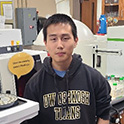
Ellison Nabi

Ellison Nabi

B.S., Chemistry (Biomolecular Science), 2020, University of Wisconsin-Oshkosh
B.S., Environmental Health, 2020, University of Wisconsin-Oshkosh
M.S., Fisheries, Aquaculture, and Aquatic Sciences (Ecotoxicology), 2024, Auburn University

Ellison’s research focuses on characterizing organic compounds in wildfire ash and sediments using targeted and non-targeted analysis.


Alumni

Kamelia Afshinnia

Kamelia Afshinnia

Kamelia Afshinnia earned her Master’s degree in Civil and Environmental Engineering at the Iran University of Science and Technology and her PhD in Environmental Health from the University of South Carolina in 2018. She studied the transformation, deposition and aggregation behavior of nanomaterials in the environment and the how the interaction of nanomaterials with natural environmental components impact on these processes.

Frederic Loosli

Frederic Loosli

Frederic Loosli earned his Master’s degree in chemistry and PhD in environmental chemistry at the University of Geneva. After a postdoc in biophysics at Paris Diderot he joined Prof. Baalousha group at the University of South Carolina to investigate the detection and quantification of manufactured nanoparticles in environmental systems.

Mithun Sikder

Mithun Sikder

Mithun Sikdur earned his Master’s degree in Environmental Engineering from the University of Nottingham, UK in 2013 and his PhD from the University of South Carolina in 2019. He investigated the effect of metal and metal oxide nanoparticle size dispersity on their properties, uptake and toxicity. 

Mahmudun Nabi

Mahmudun Nabi

Mahmudun Nabi earned his B.S. from Bangladesh University of Engineering & Technology, his M.S. from the University of Stuttgart, and his Ph.D. in Environmental Health Sciences from the University of South Carolina in 2022. His doctoral research focused on detecting, quantifying, and monitoring titanium dioxide engineered particles in urban and rural surface waters, including their variation with rainfall, runoff, and urbanization.

Amar Alshim

Amar Alrshim

Amar Alrshim earned his M.S. in Food Science and Biotechnology from the University of Basrah and his Ph.D. in Environmental Health Sciences from the University of South Carolina in 2022. His doctoral research investigated how chemical and biological synthesis approaches influence the physicochemical properties, environmental fate, and toxicity of silver nanoparticles, with particular emphasis on their effects on juvenile marine clams.

Talal Alshehri

Talal Alshehri

Talal Alshehri earned his B.S. in Environmental Health, his M.P.H. from Eastern Kentucky University, and his Ph.D. in Environmental Health Sciences from the University of South Carolina in 2025. His doctoral research investigated metals, metalloids, and incidental nanomaterials in wildland-urban interface (WUI) fire ash and their potential impacts on marine phytoplankton.

Mahbub Alam

Mahbub Alam

Mahbub Alam earned his B.S. and M.S. from Jahangirnagar University, a second M.S. from Istanbul Technical University, and his Ph.D. in Environmental Health Sciences from the University of South Carolina in 2026. His doctoral research focused on the characterization, formation, transformation, and environmental fate of incidental nanomaterials and environmentally persistent free radicals (EPFRs) in wildland-urban interface fire ash.

JingJing Wang

JingJing Wang, Ph.D.

B.S. Applied Chemistry, 2007, Wuhan University (China)M.S. Analytical Chemistry, 2010, WIPM, Chinese Academy of Sciences (China)Ph.D. Applied Chemistry, 2017, Colorado School of Mines (USA) Dr. Wang’s current research focuses on monitoring engineered and incidental nanoparticles in environmental systems. Contact


Challenge the conventional. Create the exceptional. No Limits.

©